

Does Public Parking Count as Part of a Commercial Property in Uptown Whittier?
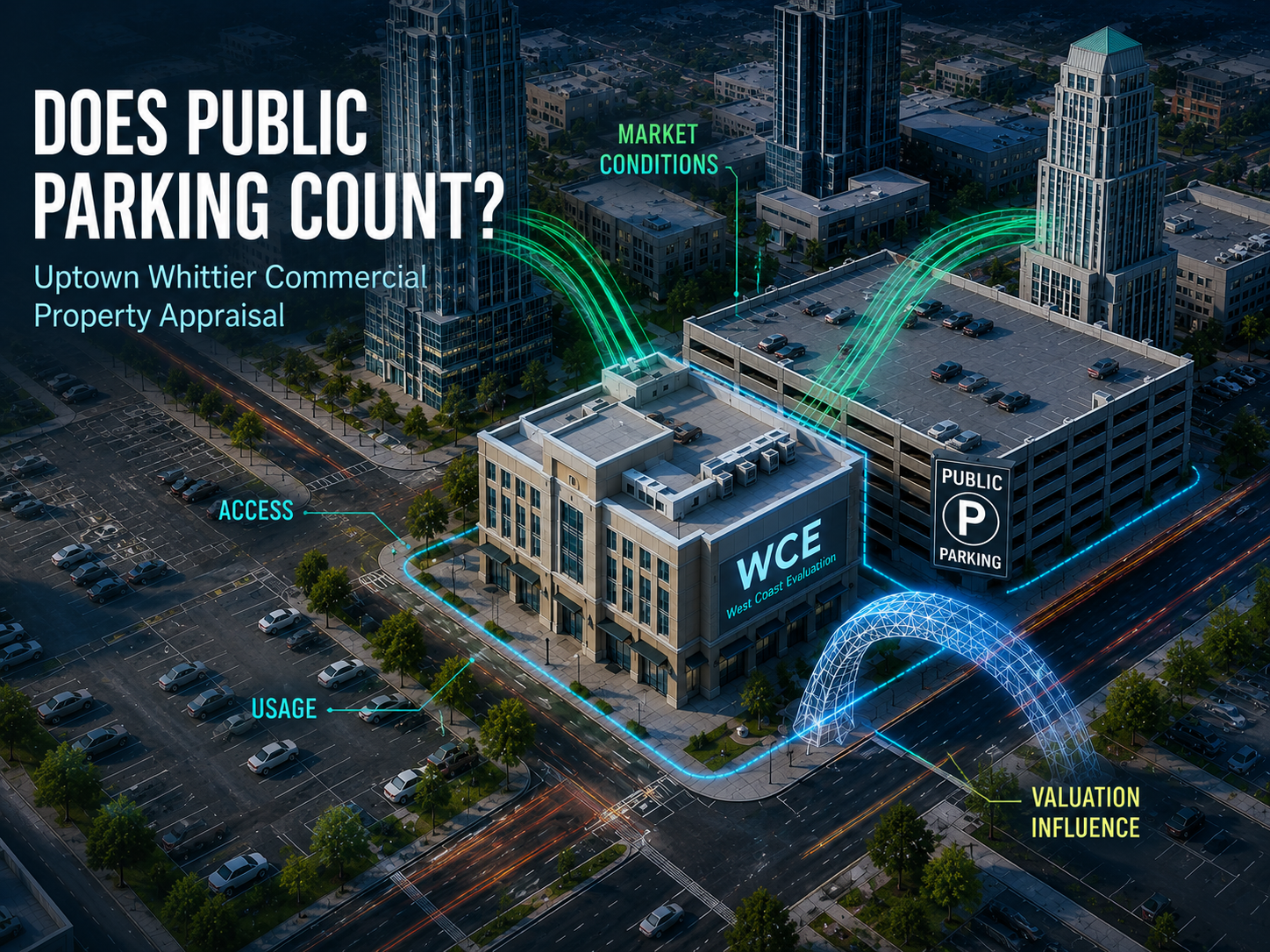
Isometric illustration of an Uptown Whittier commercial property showing how public parking, access, usage, and surrounding market conditions can influence commercial real estate valuation without necessarily being part of the property being appraised.
Quick Answer
Public or off-site parking can matter to a commercial property's appraisal without automatically becoming part of the property being appraised.
An appraiser must separate two questions: what real property and property rights belong to the subject, and what surrounding market conditions affect how that property functions and competes.
In Uptown Whittier, that distinction matters because commercial properties operate within a district served by public surface lots and parking structures. The existence of that parking may be relevant to a valuation, but it does not by itself establish ownership, parking rights, or a particular value effect for an individual property.
Why this matters in Uptown Whittier
Uptown Whittier is served by a broader district parking system.
Research completed for West Coast Evaluation's Whittier commercial work identified:
- 10 public surface parking lots serving the Uptown district
- 2 public parking structures
- 8 of the 10 surface lots carrying a three-hour limit
- 4 public lots offering monthly permits through City Hall
- 1 public lot posted as having no permit parking
Those facts help describe the commercial environment.
They do not tell us, by themselves, what parking belongs to a specific property.
A building may have on-site parking. It may be served partly by public parking. There may be an easement, lease, private agreement, or another property-specific arrangement.
That is why the appraisal has to begin with the subject property rather than a district-wide assumption.
The parcel boundary and the value analysis are not the same thing
This is the key distinction.
A parcel boundary identifies the land involved in the appraisal. Property-specific evidence helps establish the rights associated with it.
But commercial properties also operate within a market.
Buyers, tenants, lenders, and other market participants may consider access, circulation, parking availability, convenience, and how the property compares with competing locations.
So a nearby public parking lot can potentially affect how a property functions without becoming part of the real estate being appraised.
Ownership answers what belongs to the property.
Market analysis helps explain how the property functions and competes.
An appraisal may need to understand both.
If the distinction matters to a current valuation assignment, see our Whittier commercial appraisal service page.
What an appraiser actually looks at
Parking analysis is more than counting spaces.
Depending on the property and the purpose of the appraisal, relevant questions can include:
- Does the subject parcel contain on-site parking?
- What parking is reasonably available to customers, occupants, employees, or visitors?
- Are there recorded easements, leases, agreements, or other property-specific rights affecting parking?
- Are there restrictions or operating conditions relevant to the assignment?
- How does the property's parking situation compare with competing commercial properties?
- Does the market appear to respond to that arrangement?
The objective is not to label public parking as automatically good or bad.
It is to understand the actual arrangement well enough to determine whether it matters to the valuation.
Can off-site parking affect commercial property value?
Yes, it can. But the effect is not automatic.
Parking can be one of several characteristics affecting commercial utility and marketability.
Depending on the property type and the market, participants may consider:
- customer convenience
- employee and tenant access
- distance between parking and the building
- restrictions affecting use
- competing properties' parking arrangements
- whether the available parking supports the property's actual use
The better appraisal question is not simply:
"Is there public parking nearby?"
It is:
"How does this property's parking situation compare with what the relevant market expects?"
A public lot across the street should not automatically be treated as a property right.
It also should not automatically be ignored if the surrounding parking environment is relevant to the decisions of buyers, tenants, or other market participants.
Why this distinction matters to lenders and investors
For financing and investment decisions, it is particularly important to separate property rights from surrounding infrastructure.
A lender needs an appraisal of the property interest that is actually the subject of the assignment.
Public parking does not automatically become part of the collateral simply because occupants or customers use it.
At the same time, the way a property is served can still matter to its market position.
The appraisal therefore needs to distinguish between:
- what is actually part of the property
- what rights can be supported by property-specific evidence
- what surrounding conditions may affect the property's use
- how the relevant market responds
That distinction helps prevent a convenient neighborhood feature from being mistaken for an ownership right.
What if the building has its own parking?
Then the appraisal analyzes the property that actually exists.
The presence of a public parking system in Uptown Whittier does not mean every commercial property lacks private parking.
Individual properties can have different:
- physical characteristics
- parking configurations
- property rights
- occupancy patterns
- operating needs
- relationships to surrounding infrastructure
A building with on-site parking should not be forced into the same assumptions as one without it.
Property-specific facts control.
Parking rights and parking availability are different
A parking space may be available to the public without creating a private property right for a nearby owner.
Conversely, a property may have rights established through recorded documents, easements, leases, or private agreements.
Those are different situations.
An appraiser can review relevant property-specific documentation available for the assignment and identify what the evidence supports.
Where a legal determination falls outside the appraisal assignment, it should not simply be assumed.
Clear appraisal work distinguishes the evidence, the assumptions, and their relevance to value.
What about the Uptown district assessment?
The district assessment is a separate issue from parking ownership.
Uptown Whittier operates as a Community Benefit District established by property owners and privately funded by them. Research also identified additional benefit-zone geography over portions of the Uptown area.
For appraisal purposes:
An assessment concerns a charge or obligation associated with the property.
Parking concerns how the property is served, what rights can be established, and whether the market responds to that arrangement.
Those concepts should not be collapsed into one.
West Coast Evaluation's research established the existence of the district assessment, but it did not establish a universal assessment amount, rate, or formula that should be applied to an individual commercial property.
How West Coast Evaluation approaches the question
West Coast Evaluation begins with the specific property, not an assumption about the district.
For a Whittier commercial appraisal, that means identifying the subject property and property interest, understanding the intended use of the valuation and effective date, reviewing relevant property information, and investigating market conditions that may affect the property's use and competitive position.
Local knowledge is valuable because it helps identify the right questions.
It does not replace property-specific evidence.
That distinction is especially important with parking, where something can be highly visible and routinely used without necessarily being part of the real property being appraised.
The better question isn't "Where are the parking spaces?"
For a commercial property owner, investor, or lender, the more useful questions are:
- What parking is actually part of the property?
- What parking serves the property without being part of it?
- What rights or restrictions can be established?
- What does the relevant commercial market expect?
- Does the arrangement matter to the value conclusion for this particular assignment?
That is the difference between treating parking as a line on an inspection checklist and analyzing it in the context of the property's actual market.
If you are preparing for a valuation, visit Whittier Commercial Appraisal or use the Whittier Commercial Appraisal Success Kit to organize the information that may be useful before the assignment begins.
Frequently Asked Questions
Does public parking become part of my commercial property?
No, not automatically. Public parking can serve a commercial property without becoming part of the real estate or property rights being appraised. Property-specific evidence is needed to establish what belongs to the subject property.
Can off-site parking affect a commercial appraisal?
Yes. Off-site parking can be relevant to accessibility, utility, tenant appeal, or marketability. Whether it affects value, and by how much, depends on the specific property and the relevant market evidence.
Does every Uptown Whittier commercial property rely on public parking?
No such assumption should be made. Uptown has a district parking system, but individual properties can have different on-site parking, rights, and operating circumstances.
Can an appraiser determine whether my property has parking rights?
An appraiser can review relevant property-specific documentation available for the assignment and identify what the evidence supports. Recorded easements, leases, agreements, and other documents may be relevant. Legal determinations outside the appraisal scope should not be assumed.
Does a district assessment affect commercial property value?
It can be relevant to a commercial property analysis, but its treatment depends on the specific property, assignment, and market evidence. The district assessment should not be confused with ownership of public parking.
What should I give an appraiser if the parking situation is complicated?
Provide whatever relevant records you have. These may include title documents, leases, easements, parking agreements, site plans, or other records describing parking or access. The appraiser can determine which materials are relevant after the assignment is understood.
Key Takeaways
- Public parking does not automatically become part of a nearby commercial property.
- Off-site parking can still be relevant to commercial utility and marketability.
- Parking availability and parking rights are different questions.
- Uptown Whittier's district parking system does not create the same circumstances for every property.
- Property-specific evidence should drive the appraisal analysis.
- Local knowledge is most valuable when it leads to better questions, not broader assumptions.
Final Word
A commercial appraisal should value the property that actually exists, with the property rights that can actually be supported.
But it should also understand the market in which that property competes.
In a district like Uptown Whittier, public and off-site parking can sit directly at the intersection of those two ideas.
West Coast Evaluation approaches that distinction by separating ownership from market influence, then determining what the evidence supports for the specific property and valuation assignment.
If you're preparing for a commercial appraisal in Whittier, explore Whittier Commercial Appraisal.
👉 Visit the FAQ Hub
👉 Explore the Resource Hub
👉 View Areas We Serve
**[Need a property-specific valuation? Learn more about our Whittier Commercial Appraisal services and how West Coast Evaluation analyzes commercial property rights, market influences, and valuation factors unique to Whittier.
Whittier Commercial Appraisal]1**